A familiar place, after a long while
The lakes were waiting.
The original reason I began updating my kayak journeys was that they led up to visits to one of my favorite places. The other trips were so fun, I felt it would be a shame to jump right to my visit to Ohio Power Recreation Land.
Click a photo to see its full-resolution original.
01 · The road in
One Thursday, I finally went
I believe it was on a Thursday. I was at a point where I could hang out around the house and do nothing or spring into action. I had failed to visit Ohio Power for several years. I loaded the kayak and made a run for Cumberland, the gateway to Ohio Power.
I passed through Zanesville with low fuel, but figured I would get it in Caldwell at the BP station. Unfortunately for me, this station no longer existed. I figured I'd get gas at Old Man's Money along with a big scoop of ice cream.
When I arrived in Cumberland there was a construction crew on the roadway. I asked if they still had gas at Reinersville, Old Man's Money, but they told me the closest gas was at Bell Valley. It was a good 18-mile round trip, but I took it rather than running out of gas.
I finally made my way to Rusty's friends, the Shoemakers. Mike let me park my car at his place. I took the kayak across the road and began down the old road bed. A huge tree was down and it was so big I had to go around it.

02 · First pond
Down through the olives
Finally I made it to the point where you leave the road and drop down the steep hillside to the first small lake. All trails were gone. What was even more disappointing was that the hillside was covered with Autumn Olive trees, also known as Russian olives. They totally choked the understory, but had been there long enough to grow tall enough to duck under their arching branches. Luckily, they are not as sharp as multiflora roses.
I hit the first pond and had to work hard to get through the thick aquatic vegetation. I managed to work my kayak into a muskrat path and paddled through to the main body of water. I fished for a short while, seeing mostly small bass and bluegill. I didn't want to waste time in that lake, so I went down to the next lake.
Now I was in the lake where Dad and I would drag our canoe after paddling across the Campsite Q lake. I fished my normal spots and managed to catch a keeper. Not wanting to encounter a DNR officer with a fish and no license, I speared the fish's mouth with a small beaver stick in the water for safe keeping. It was my understanding that road access was still available to Q, and I wanted to pay it a visit without unnecessary risk.

03 · Campsite Q
Cold pizza and a dragonfly
I dragged my kayak down the hill to the main lake and paddled peacefully across to the old campsite under the pine trees. The same cattails were in place. Grass and flowers were over the pull-through road that went in front of the pines. The main road was fully grassed, with some olive plants taking over. If I had not known where to look for a road, I may not have found it.
I was stuffing my face with cold pizza and saw a large dragonfly land in the nearby grass behind the campsite. I managed to take several pictures of it, inching closer each time. Finally it flew away.
Back at the lake's edge, the view was calmingly familiar: cattails gently swaying in the breeze, sporadic algae blooms near the shoreline, and remnants of old dead trees sticking out of the water. I wished I had a bucket of minnows and more time to try to catch the crappie I knew lay beneath. I knew exactly where they would be hiding, too.


A place full of old stories
The campsite, changed
While it was excellent to be back at my favorite campsite, there were a couple of downsides. The spot under the pines was grown up with 2- to 3-foot trees, many of them Black Cherry. The old fire pit from my last visit several years before was barely noticeable. I liked to visit the site with friends after the area had been closed for a wiener roast, for old times' sake.
Speaking of friends, the other sad part was that Ray was not there to share the melancholy. Ray and I began camping at this location as soon as we were old enough to camp on our own. It was also sad that Rusty was not there. Rusty and his wife Espie took Ray's place as camping companions after Ray joined the Marines.
I chomped down the last piece of pizza and began paddling for the main Lake Q dam.

04 · A return trip
The beaver shoot
I typed the first part of this story up in the winter following my June 2006 trip to the rivers and Ohio Power. Now I continue after two additional trips to the area and a year and a half after writing the first part.
I managed to devour my pizza by the time I made it to the steep beaver shoot that goes up the hill to the next lake. This beaver shoot is relatively clear of trees, but slippery and challenging to climb. Once up, I crossed the old road bed where, in the 1970s, Dad and I would have to park his VW Bug as we walked the rest of the way to our favorite lakes.
I managed to stay on top of the beaver muck as I stepped into the cattails and launched my kayak into the shallow end of this 30-plus-year-old beaver-dammed lake. I quickly caught another keeper. It wasn't a large fish, just a nice catch. Keeping it was a mistake, though. As I worked my kayak to the deep underwater trench where the beastly bass lie, I attracted one with my lure.
I could tell it became more interested in the smaller fish I had caught, which was swimming beneath and attached to my boat. This huge bass swam up to my catch, appeared to check out my kayak, then slowly began to sink to the lower depths of the trench, disappearing out of sight.
05 · The canal
A lesson in beaver muck
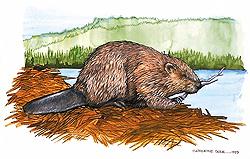
I made my way to the beaver canal that separates this lake from my dad's favorite lake. The canal was very dry and I had to get out and walk part of the way. This was difficult since the only place to walk was the dry canal bed, mostly composed of what I call beaver muck.
Beaver muck is an interesting soil type often found near beaver dams, but it can be found anywhere near lakes and ponds. The surface may appear as a light gray silt. The soil is as slick as ice. If the surface has dried and the underside is still wet, one of two things will happen when you try to walk on it. First, you make your step, then you go flying through the air! The dried part easily slips on top of the lower muck, which seems to be self-lubricating.
The other thing that happens is that you slowly step on the muck and feel the dried, solid texture of the surface. You do not slip, but as you bear your full weight on one foot to take a step, you instantly sink to your knee or deeper. It is almost as bad as quicksand and worse in several aspects. Beaver muck stinks!
I suppose I could pull out my old agronomy book and tell you what this stuff is really made of, but I'll just describe it from basic observation and experience. The muck is black and must be composed of decaying plants and other matter. Once you penetrate the surface, a nasty sulfur smell emerges from all around you. Some of the decay process must be trapped within; with the weight of your leg sinking in, it bubbles up and out of nearby water and muck.
It seems to stick like grease. I would use pudding to describe its consistency, but that would conjure up a more pleasant vision of the stuff. Take note: all this can happen if you carelessly try to step onto apparently dry beaver muck.
Needless to say, I penetrated the beaver muck with one foot before I figured out how to push the kayak in front of me where I couldn't go around, then step into the boat for support. I searched ahead for a rock or firm ground, stepped out of the boat forward, and repeated until safe from the gooey mess that makes up the infamous beaver muck.
06 · Last light
One more lake before dark
Finally, I was in Dad's favorite lake, which had an odd green color to it. I caught another fish. It was getting dark and I had a lot of territory to cover for the journey back. I took the boat out at the path that leads to the second lake I visited, the one with the fish I had staked out.
I returned to the fish and, in the crystal-clear water, saw that only pieces of it remained. Some hungry animal saw it as an easy meal. I have seen mink in the area and sort of imagine that is what got it.
I retraced my paddle back to the first pond that I visited and pulled out to begin up the hill of Russian olives. This hill would be a challenge to climb even if it had a paved path. Now the sun was down and I could only look for twilight at the top of the hill through the dense underbrush. I climbed without direction, knowing as long as I was going up I would eventually find the road.
Dripping with sweat and bleeding from rosebush thorns, I climbed. Finally at the top I was closer to the old cemetery than to where I had parked. Now I was really a sight and smell: covered with dirt from the low branches, smelling of sweat and beaver muck and, in some areas, a bloody mess. It felt great to have the old heart pumping again!
I visited the Shoemakers for a bit while I recovered and cleaned the fish with a dull knife. Then I had a safe journey back to Newark for a hot shower and a good night's rest.

Shoreline keepsakes
The old roads and campsites
The access roads have softened back into the landscape, but the old places are still there if you know where to look.
